
OHIO COLLABORATIVE
Due to a series of events in Ohio and elsewhere in the nation, the fractured relationship existing between some local communities and the law enforcement agencies dedicated to serving them has been highlighted. In an effort to resolve this conflict, in December, 2014, Governor John R Kasich signed Executive Order 2014-06K creating the Ohio Task Force on Community-Police Relations. Since its creation, the Task Force developed recommendations on how to improve relationships between law enforcement and their respective communities.
On April 30, 2015, Governor Kasich signed Executive Order 2015-04K establishing the Ohio Collaborative Community-Police Advisory Board. The purpose of the Collaborative is to advise and work with the Office of Criminal Justice Services (OCJS) in the Ohio Department of Public Safety to implement the Task Force’s recommendations.
On March 15, 2024, Governor Mike Dewine signed Executive Order 2024-05D that re-established the Ohio Collaborative Community-Police Advisory Board and Certification Program as well as the creation of the Ohio Collaborative Law Enforcement Accreditation Program.
The Ohio Collaborative Law Enforcement Accreditation Program recognizes agencies that voluntarily meet all certification standards and any additonal standards developed. Agencies that meet these standards will attain the highest level of professionalism. The Accreditation Program was created with the goal of creating meaningful and sustainable standarization of law enforcement practices while increasing transparency for the community.
In 2026, the Ottawa County Sheriff’s Office is pleased to announce that it is one of twenty-four agencies across the state of Ohio to achieve accreditation status. Accreditation status is reviewed annually by the state of Ohio via the Office of Criminal Justice Services. Accreditation is the responsibility of Director of Training and Compliance Jeff Griffin.


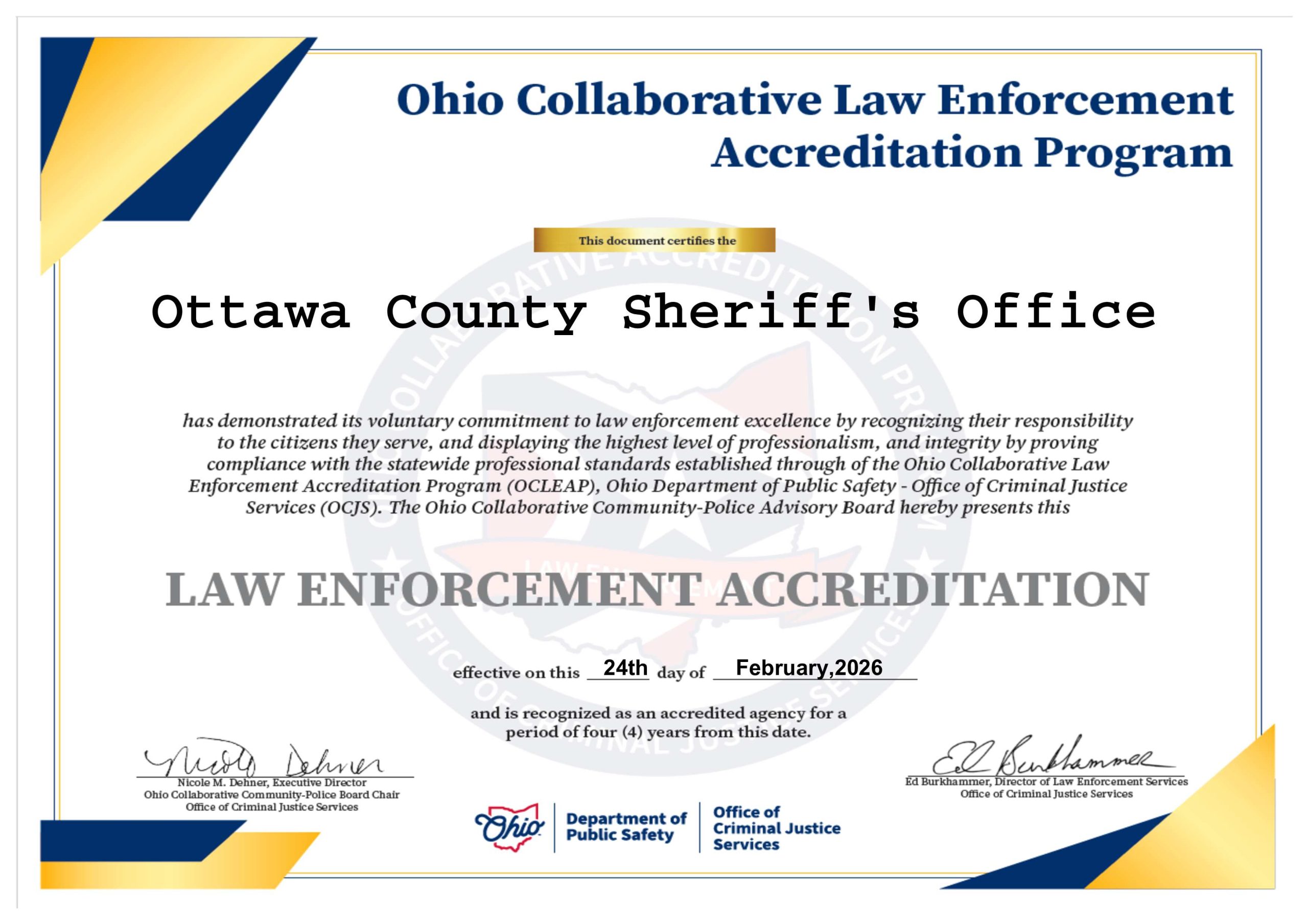
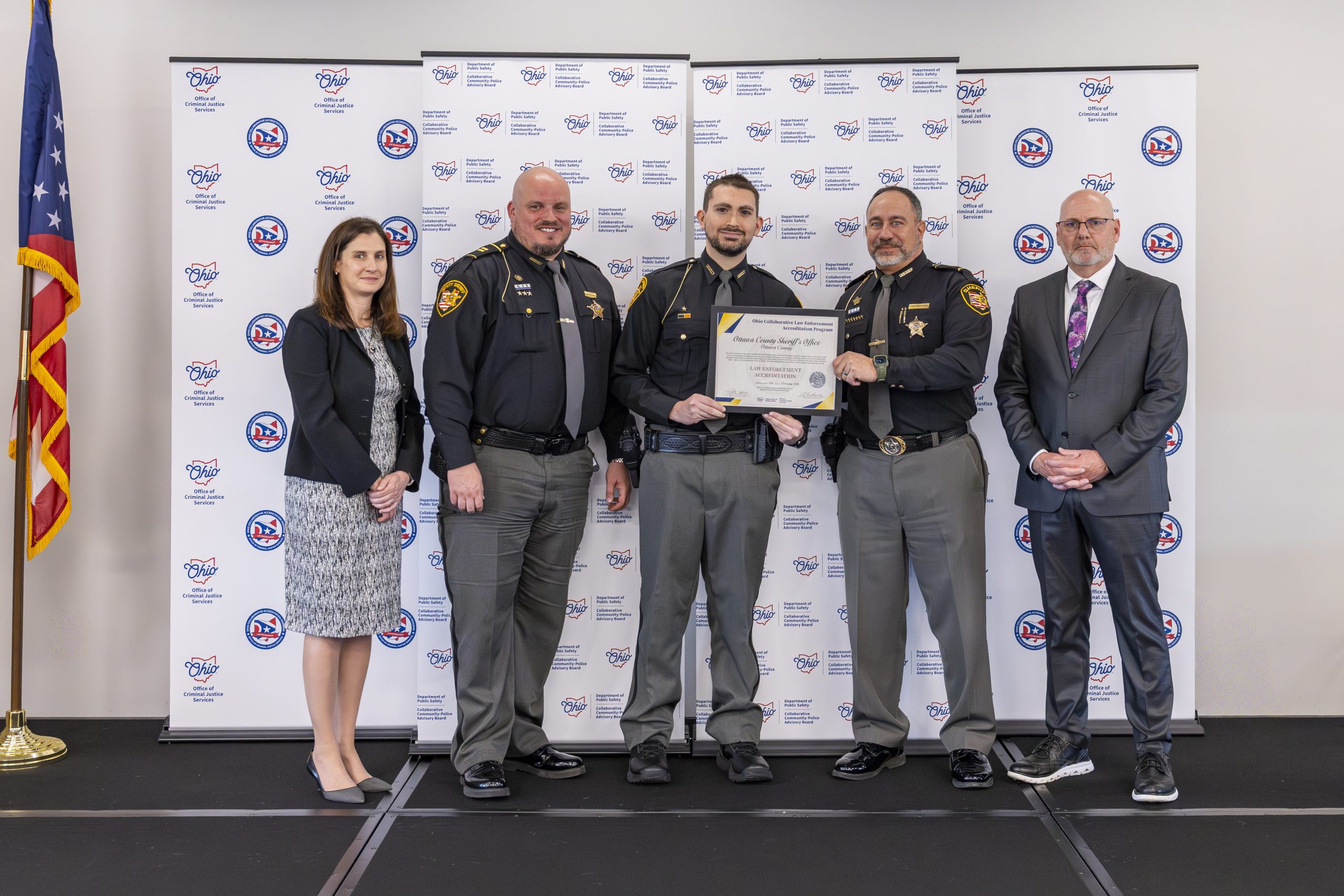
ACCREDITATION STANDARDS
Chapter 1 Administration & Organization
1.01: Written System of Agency Directives
1.02: Agency Property/Equipment
1.03: Written Goals and Objectives
Chapter 2 Professional Standards & Conduct
2.01: Professional Conduct
2.02: Investigation of Employee Misconduct
2.03: Bias-Free Policing
2.04: Unlawful Harssment
Chapter 3 Training
3.01: Career Development
3.02: Telecommunicator Training
Chapter 4 Personnel
4.01: Agency Employee Recruitment
4.02: Agency Employee Hiring
4.03: Agency Wellness
4.04: Performance Evaluation
4.05: Early Intervention System
Chapter 5 Records & Information Management
5.01: Records Policy
5.02: Collection and Reporting of Data
Chapter 6 Use of Force
6.01: Use of Force
6.02: Use of Deadly Force
Chapter 7 Law Enforcement Operations
7.01: Patrol
7.02: Evidentiary Audio/Video Data
7.03: Vehicular Pursuit
7.04: Youth Standard
7.05: Crisis Intervention
7.06: Knock and Announce and No-Knock Entries
7.07: Strip and Body Cavity Searches
7.08: Community Engagement
7.09: Arrest with and without Warrant
7.10: Missing Persons
Chapter 8 Unusual Occurrences
8.01 Mass Demonstrations
8.02 Specialized Units
Chapter 9 Property & Evidence Management
9.01: Property & Evidence
9.02: eTrace & NIBIN
TRANSLATIONS:
Ottawa County Sheriff's Office
Sheriff Stephen J. Levorchick
All Rights Reserved
Copyright © 2022
